Preparing for launch…
API Starter — Express + TypeScript
Production-grade Express 4 + strict TypeScript REST API starter: JWT auth with refresh rotation, zod validation, typed errors, rate limits.
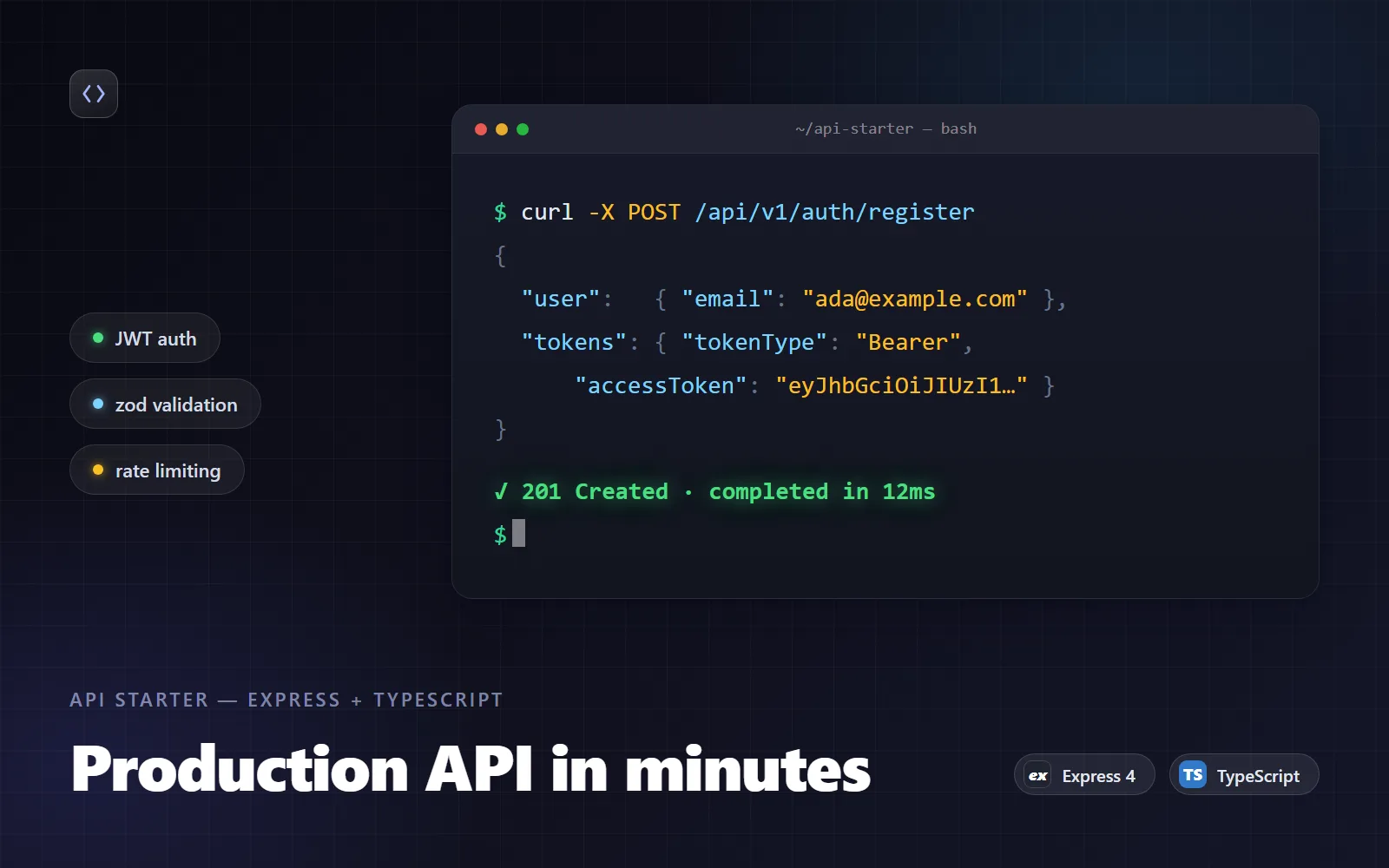
What it does & who it's for
API Starter is the Express + TypeScript foundation you keep rebuilding on every backend project, done properly once: strict-mode TypeScript across 22 source files, zod validation on every input (env config, bodies, queries, params), JWT authentication with access + refresh tokens, a typed error envelope with stable machine-readable codes, per-IP rate limiting, structured JSON logging with request ids, and a clean layered architecture (routes → controllers → services). One example resource — projects CRUD with pagination, filtering, sorting and ownership scoping — is wired end to end so every pattern is demonstrated in a real request path, not a comment. The auth is the part most starters get wrong, and the part this one takes seriously. Refresh tokens are single-use: every refresh consumes the presented token server-side and issues a new pair, and replaying an already-consumed token is treated as theft — every session for that user is revoked. Passwords are bcrypt-hashed (cost 12, configurable), and login burns identical hash time for unknown emails and wrong passwords so response timing never leaks who has an account. Clients drive the whole flow off stable error codes like TOKEN_EXPIRED — never string-matching on messages. It runs with zero external services: typed in-memory stores stand in for persistence, so npm install to an authenticated, rate-limited API is about two minutes. The stores are deliberately shaped like tables, and README-setup.md maps the exact seams — two service files — where Postgres/Prisma, Mongo or anything else plugs in while controllers, routes, schemas and middleware stay untouched. Adding your own resource is four files copied from the projects example plus one mount line. Wiring this yourself — refresh rotation with reuse detection, a central error handler that never leaks internals, env validation that fails loudly at boot, graceful SIGTERM draining — is comfortably a week of careful work, and every shortcut becomes a production incident later. Try the live demo first: it is a static docs preview generated from the real shipped source, showing every endpoint, the auth flow and actual code from the package before you pay.
What's included
- 22 TypeScript source files (src/**): Express app assembly, server bootstrap with graceful shutdown, zod-validated env config, and the full auth + projects request paths - Auth done right: JWT access + refresh with single-use rotation and reuse detection, bcrypt password hashing, timing-safe login (src/services/auth.service.ts, src/lib/jwt.ts) - Middleware suite: requireAuth bearer guard, zod validate for body/query/params, central typed error handler, fixed-window rate limiter, request logger with correlation ids (src/middleware/*.ts) - Typed error toolkit with stable machine-readable codes (src/lib/errors.ts) and a dependency-free structured JSON logger (src/lib/logger.ts) - Example resource wired end to end: projects CRUD with pagination, filtering, sorting and ownership scoping (schemas → routes → controllers → services) - package.json with real pinned dependencies and dev/build/start scripts, strict tsconfig.json, fully commented .env.example - README-setup.md: two-minute quick start, endpoint table, auth flow explainer, database-swap guide, production checklist, troubleshooting - api-reference.md: request/response examples for all 11 endpoints, error code table, rate-limit headers, client auth-flow pseudo-code
What's not included
- No database or ORM — typed in-memory stores by design; README-setup.md maps exactly where Postgres/Prisma or Mongo plugs in (two files) - No Docker files, CI pipeline or deploy configs - No automated test suite — the layering keeps services unit-testable and the app factory is supertest-ready - No OAuth or social login — email + password with JWT only - No frontend or API client code
Requirements
Node.js 18.17+ (any current LTS); npm, pnpm or yarn; comfort with TypeScript and Express to extend the code (this is a source-code starter, not a no-code tool). No database or external services required to run it.
Setup instructions
1. Download the deliverables and copy the folder into your workspace, then open a terminal in it. 2. Copy .env.example to .env — the defaults boot as-is for local development; before deploying, generate real secrets with: node -e "console.log(require('crypto').randomBytes(48).toString('hex'))" and set JWT_ACCESS_SECRET and JWT_REFRESH_SECRET (they must differ). 3. Run npm install. 4. Run npm run dev — you should see a JSON log line: "server started" on port 3000. 5. Smoke-test: curl http://localhost:3000/health, then register via POST /api/v1/auth/register and call GET /api/v1/projects with the returned Bearer token — exact curl commands are in README-setup.md. 6. For production: npm run build, then npm start with NODE_ENV=production behind your proxy of choice.
Version history
- v1.0Latest6 Aug 2026
Licence & terms
Licence terms
Single-project commercial licence. You may use API Starter as the foundation of one commercial or personal project (one production deployment), modify the source freely, and ship it as part of that project. You may not resell, redistribute, sublicense or repackage the source — modified or not — as a boilerplate, starter kit, template or competing product, and you may not share it outside the team working on the licensed project. Purchase one licence per project.
Refund policy
14-day refund policy: if the package is materially not as described, contact us within 14 days of purchase for a full refund. Please try the live demo first — it is generated from the real shipped source and shows every endpoint, the auth flow and actual code from the package, so you know exactly what's in the box before you pay. Refunds are not offered for change of mind. An approved refund ends your licence to the product — you must delete all copies of the files and stop using them.
Support terms
Email support for setup questions, bug reports and integration help (environment config, auth flow questions, guidance on the database-swap seams) for 6 months from purchase. Building custom features, writing your migrations and project-specific consulting are out of scope.
These terms are snapshotted at purchase — what you see here is what applies to your order.
Reviews
No reviews yet
Reviews come from verified purchasers only, so you can trust what you read here.
More in Developer Tools
Other listings buyers compared with this one.
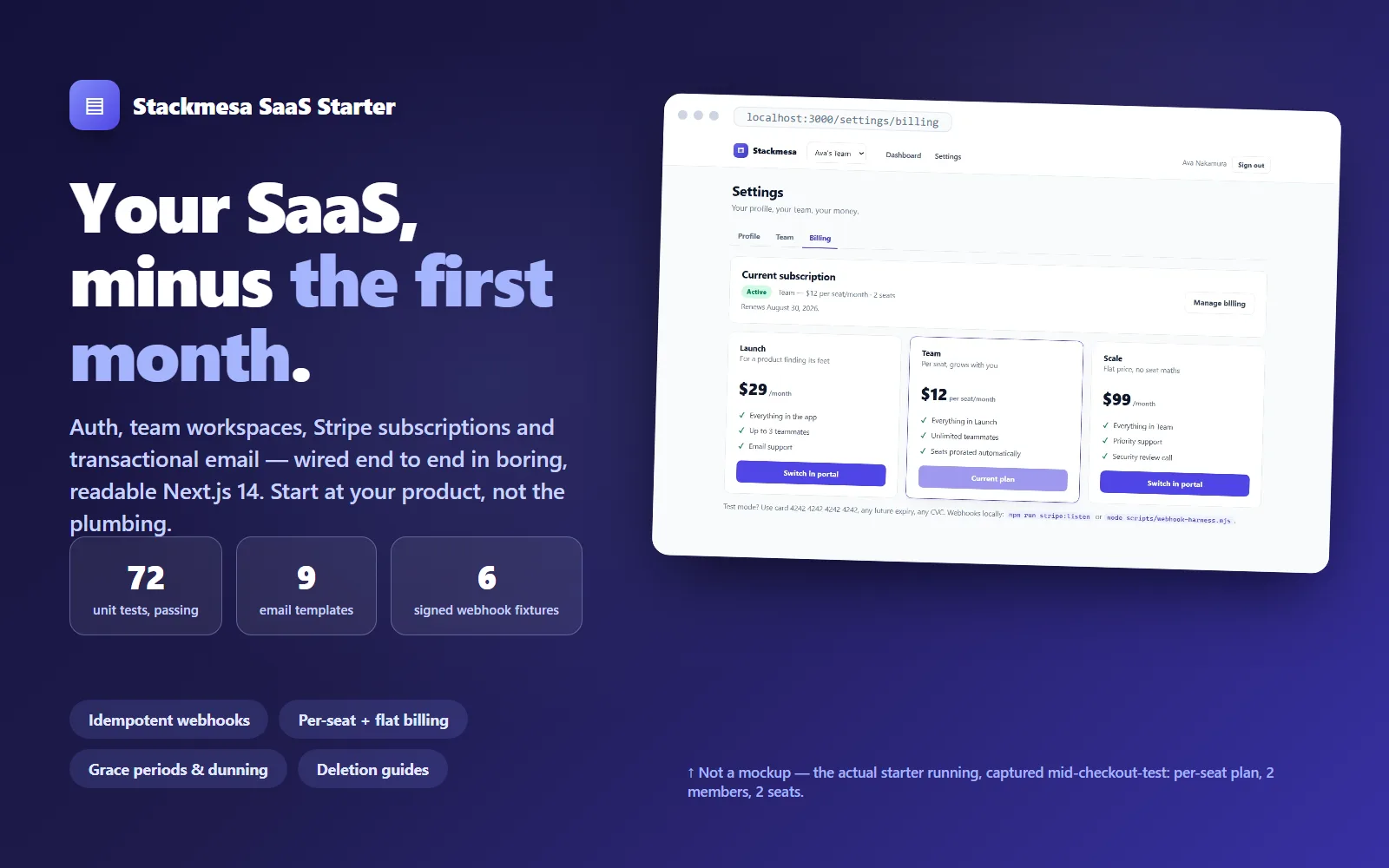 Test-run
Stackmesa SaaS Starter
A production-grade Next.js 14 SaaS starter — auth, team workspaces, Stripe subscriptions and transactional email wired end to end, tested, and documented so every module can be deleted cleanly.
5.0(1)
Live demoStackmesa$399
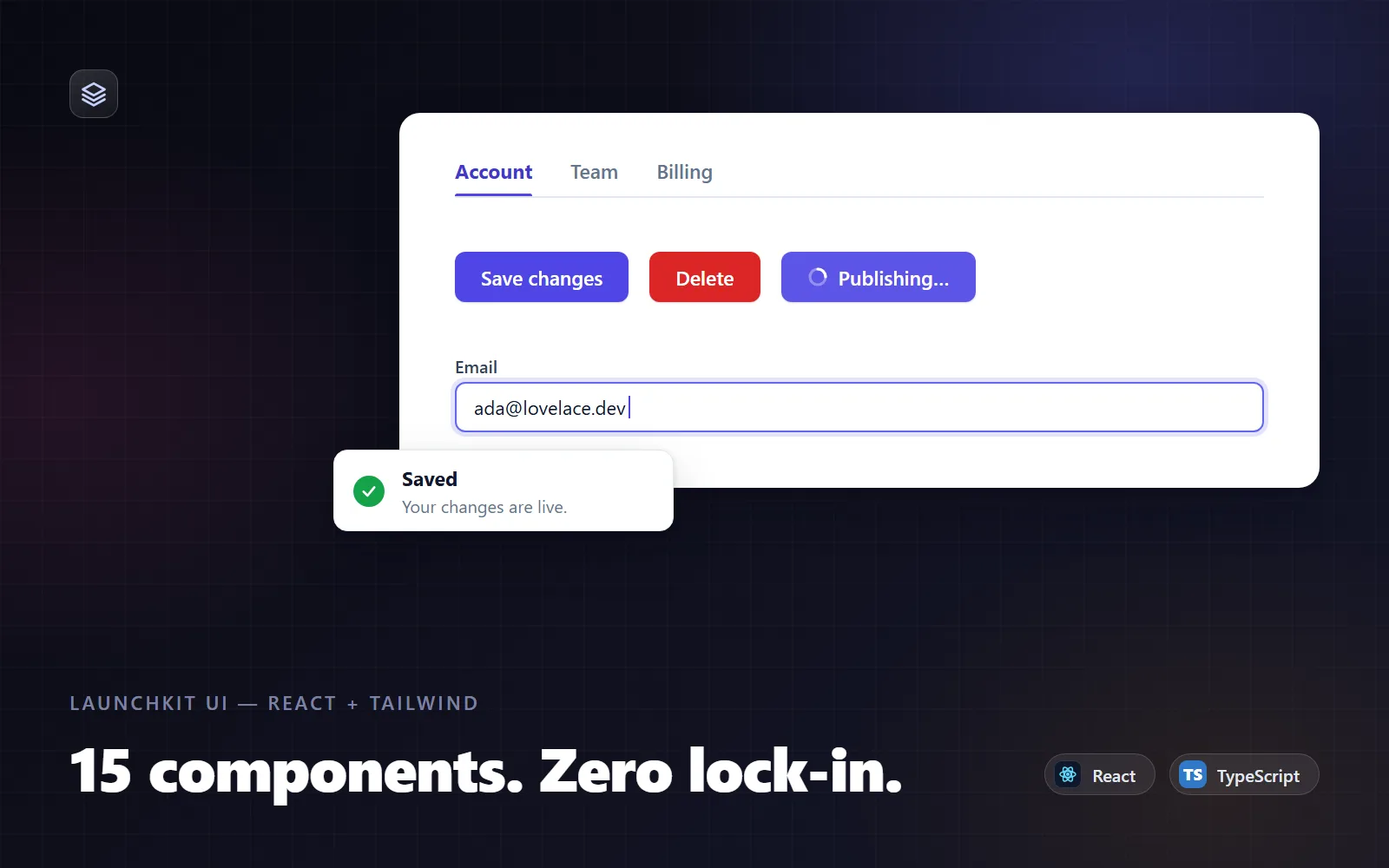 Test-run
LaunchKit UI — React + Tailwind Component Pack
15 accessible, production-ready React + Tailwind components in TypeScript — copy them in, register one preset, ship.
Live demoStackmesa$59