Preparing for launch…
BriefBot — AI Proposal Writer
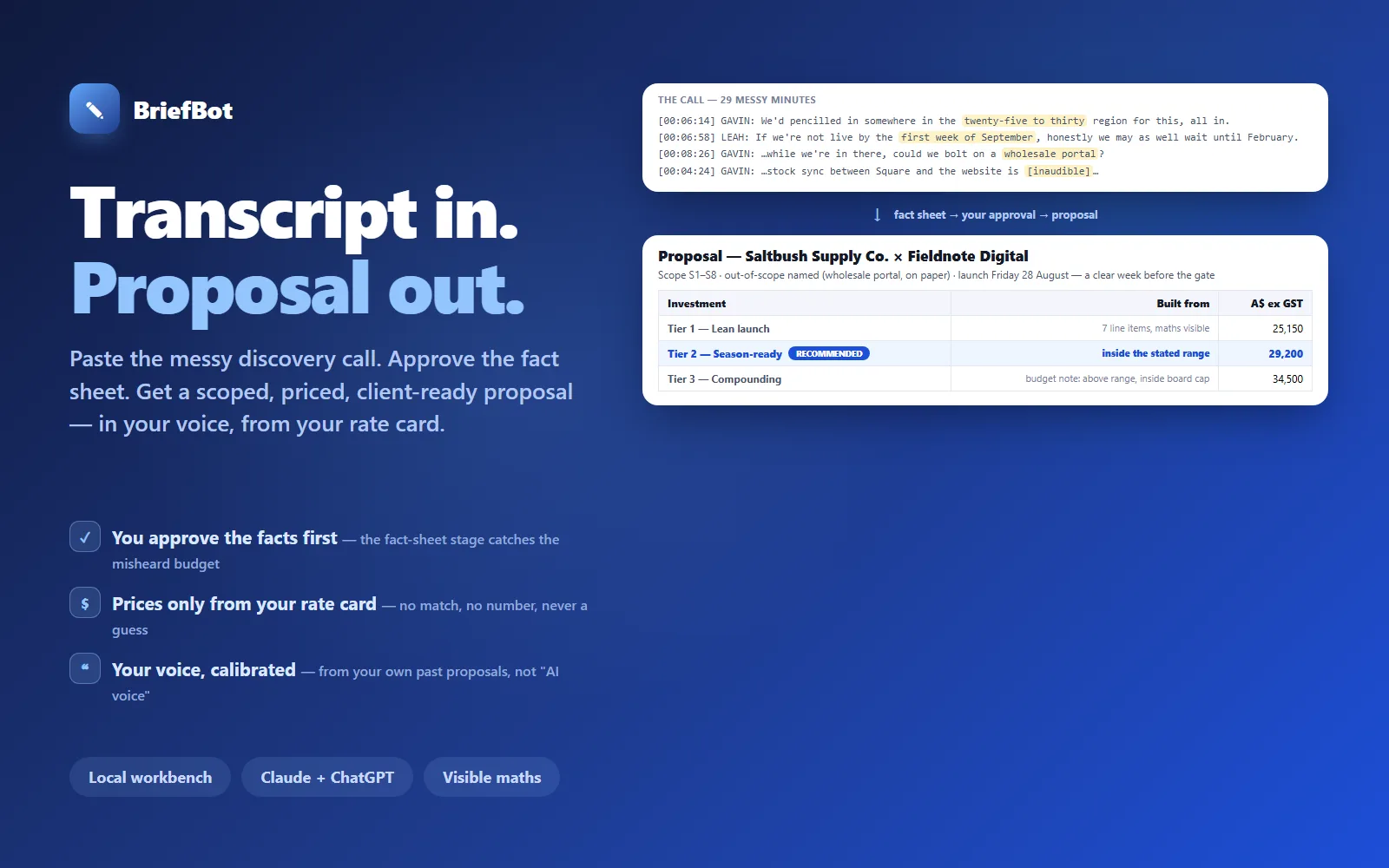
Paste a discovery-call transcript; approve a fact sheet; get a scoped, priced, client-ready proposal in your voice — priced only from your rate card, never from guesses.
What it does & who it's for
The proposal is where deals die: three days late, priced by vibe, written in a voice that isn't yours. BriefBot turns the discovery call you already had into the proposal it should produce — through a pipeline built on one principle: the model drafts, you control the facts. Stage 1 reads the raw transcript — crosstalk, [inaudible] tags, the budget mumbled as "twenty-five to thirty, all in" — and produces a one-page fact sheet: goals with verbatim evidence quotes, pain points with the client's own numbers, scope signals tagged requested/implied/deferred, budget signals quoted exactly (never normalised into a number they didn't say), timeline gates with their consequences, open questions, and red flags for your eyes only. You correct anything it misheard and approve. That two-minute read is the step that catches the wrong number before the client does. Stage 2 drafts the proposal from your approved facts, under non-negotiable rules. Every price comes from your rate card with the maths visible ("Template design × 4 @ 1,450 — 5,800"); work with no rate-card match gets [TBC], never a market guess. Three tiers by default — leanest-viable, recommended, stretch — with subtotals that exactly equal their line items. Budget signals position the tiers but never move a price: a tier above the client's stated range says so plainly instead of hiding. Scope only enters from the call. And red flags shape the document silently — a story about a bad former agency becomes staged milestone payments presented as standard practice, with the story never mentioned. The voice is yours because you build it: the calibration worksheet extracts a voice profile from your own past proposals, and every sentence applies it. The pack's worked example runs a realistic 29-minute e-commerce discovery call (Saltbush Supply Co.) through the full pipeline — messy transcript, fact sheet, three-tier proposal in the sample seller's voice, and the same proposal as validated JSON — so you can reproduce the samples and know your setup is exact before the first real call. The Workbench makes it a tool rather than homework: a single local HTML file with the system prompt embedded — paste transcript, load rate card, one click to copy the assembled prompts into Claude or ChatGPT, or run directly with your own Anthropic API key (browser to API, key never stored). A one-click handoff moves the approved fact sheet into Stage 2. For pipelines, the JSON schema and renderer prompt turn BriefBot into an API step with machine-checkable output. The live demo is the actual Workbench preloaded with the sample call — press Run and watch both stages produce the shipped sample outputs.
What's included
- workbench.html — the local assembly bench: system prompt embedded, copy-to-chat or direct Anthropic API mode, fact-sheet→proposal handoff, rate-card validator - system-prompt.md — the engine: two-stage pipeline, extraction rules, the non-negotiable pricing rules, missing-input behaviour, edge cases, output modes - voice-calibration-worksheet.md — build your voice profile from your own writing; includes the worked sample profile - rate-card-template.json — your prices, structured; ships as the sample card so the samples reproduce - sample-transcript.md — the test input: a realistic, messy 29-minute discovery call - sample-fact-sheet.md + sample-proposal.md + sample-output.json — the complete worked example: both stages, Markdown and JSON, your calibration targets - output-schema.json — JSON Schema for structured runs (subtotal arithmetic and policy rules machine-checkable) - renderer-prompt.md — renders stored JSON back to the client document, with seller-only notes suppression enforced - proposal-anatomy.md — why each proposal section exists and how to judge a draft in 30 seconds - README-setup.md — the 20-minute start: reproduce the samples, then make it yours
What's not included
- An AI subscription or API key (chat plans work via the copy buttons; the direct-API path costs a few cents per proposal) - E-signature or proposal-hosting software — BriefBot produces the document; send it however you send documents - CRM integration — the pipeline recipes show where BriefBot slots in, but nothing here requires a CRM - Sales coaching — it writes what the call supports; it can't fix a discovery call that didn't ask about budget
Requirements
- Claude or ChatGPT (either; the workbench copies identical prompts to both) — or an Anthropic API key for the direct path - Your rate card, entered once into the template - 30 minutes with three of your past proposals for the voice worksheet - Call transcripts (any recorder/transcriber export works — the system is engineered for messy, unedited text)
Setup instructions
1. Open workbench.html — it's preloaded with the sample voice profile and rate card. 2. Run the calibration: paste sample-transcript.md, run Stage 1, and compare against sample-fact-sheet.md; approve and compare Stage 2 against sample-proposal.md. Matching outputs prove your assembly is exact. 3. Replace the rate card with your real prices (Validate button checks the shape) and do the voice worksheet — these two files are 90% of output quality. 4. First real call: paste the transcript, read the fact sheet like an editor, correct, approve, and read the proposal before it leaves the building. 5. Optional pipeline: OUTPUT: JSON + output-schema.json for validation, renderer-prompt.md for on-demand client documents.
Version history
- v1.0Latest5 Aug 2026
Licence & terms
Licence terms
Single-business commercial licence. Use BriefBot to produce proposals for one business — freelancer or agency — and adapt the prompts, workbench, rate card and voice profile freely for it. Proposals you produce are entirely yours. You may not resell, redistribute or re-list the prompt system, workbench, schema or samples as a template, prompt pack or product, whether paid or free.
Refund policy
14-day refund if the product is materially not as described in this listing or its demo. The demo is the real workbench replaying the complete worked example — judge the fact sheet's extraction and the proposal's writing before buying. Refunds are not offered for change of mind or for third-party AI costs. Open a refund request from your Launchstock library and we will respond within 2 business days. An approved refund ends your licence to the product — you must delete all copies of the files and stop using them.
Support terms
Email support (hello@thornelabs.dev) for 3 months from purchase, replies within one business day. Covers the calibration run, rate-card structure, voice tuning, workbench use and the pipeline recipes on unmodified files. Custom output structures or CRM-specific integrations are available as paid work.
These terms are snapshotted at purchase — what you see here is what applies to your order.
Reviews
No reviews yet
Reviews come from verified purchasers only, so you can trust what you read here.
More in AI Tools
Other listings buyers compared with this one.
 Test-run
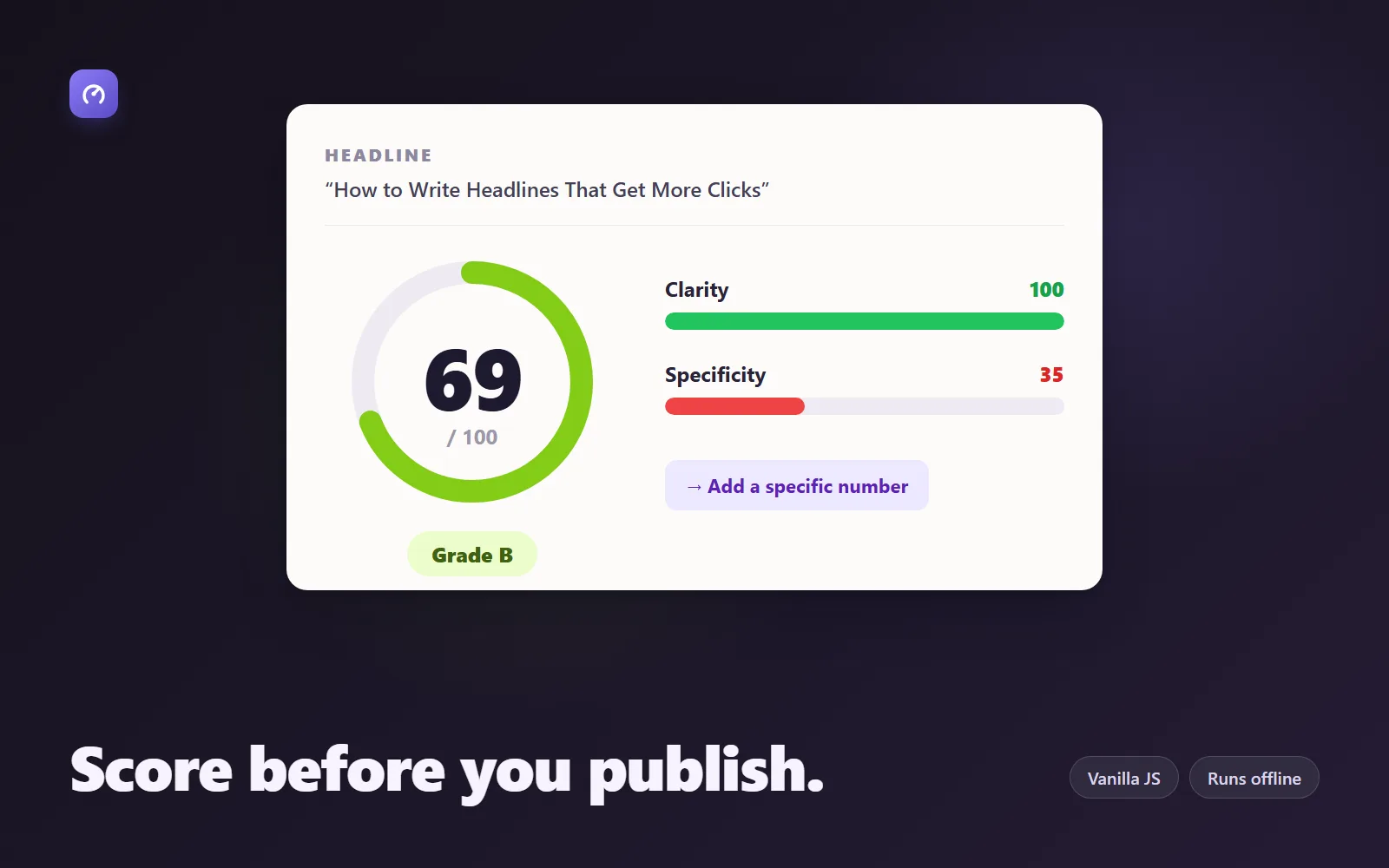
Headline Studio — Scoring Engine + 60 Formulas
Paste a headline, get a 0–100 score across 5 research-backed dimensions plus concrete rewrites. Pure JS — no AI calls, no account.
Live demoThorne Labs$35
 Test-run
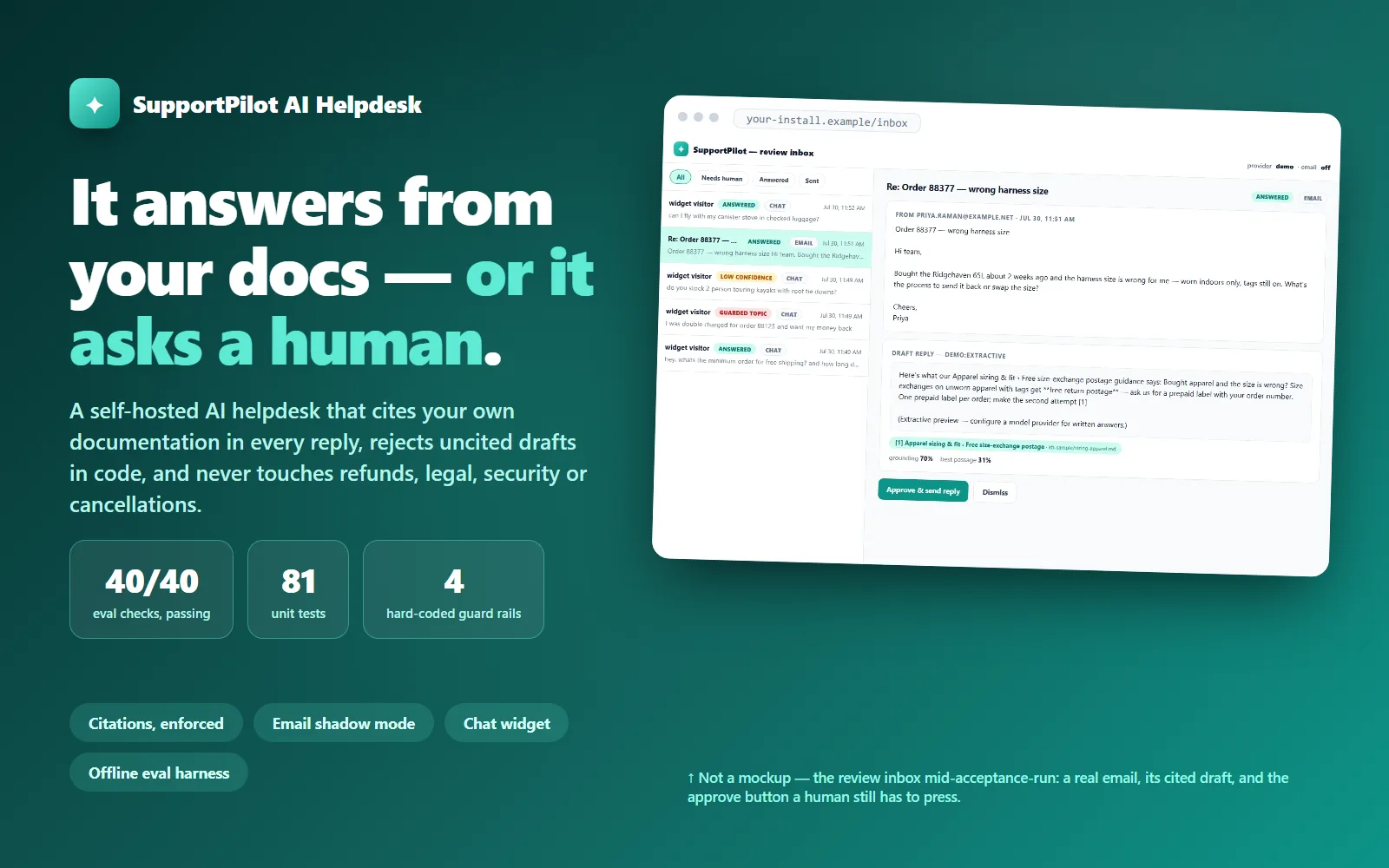
SupportPilot AI Helpdesk
A self-hosted AI helpdesk that answers only from your own docs with citations validated in code, hands anything ungrounded to a human, and never touches refunds, legal, security or cancellations.
Live demoThorne Labs$449
 Test-run
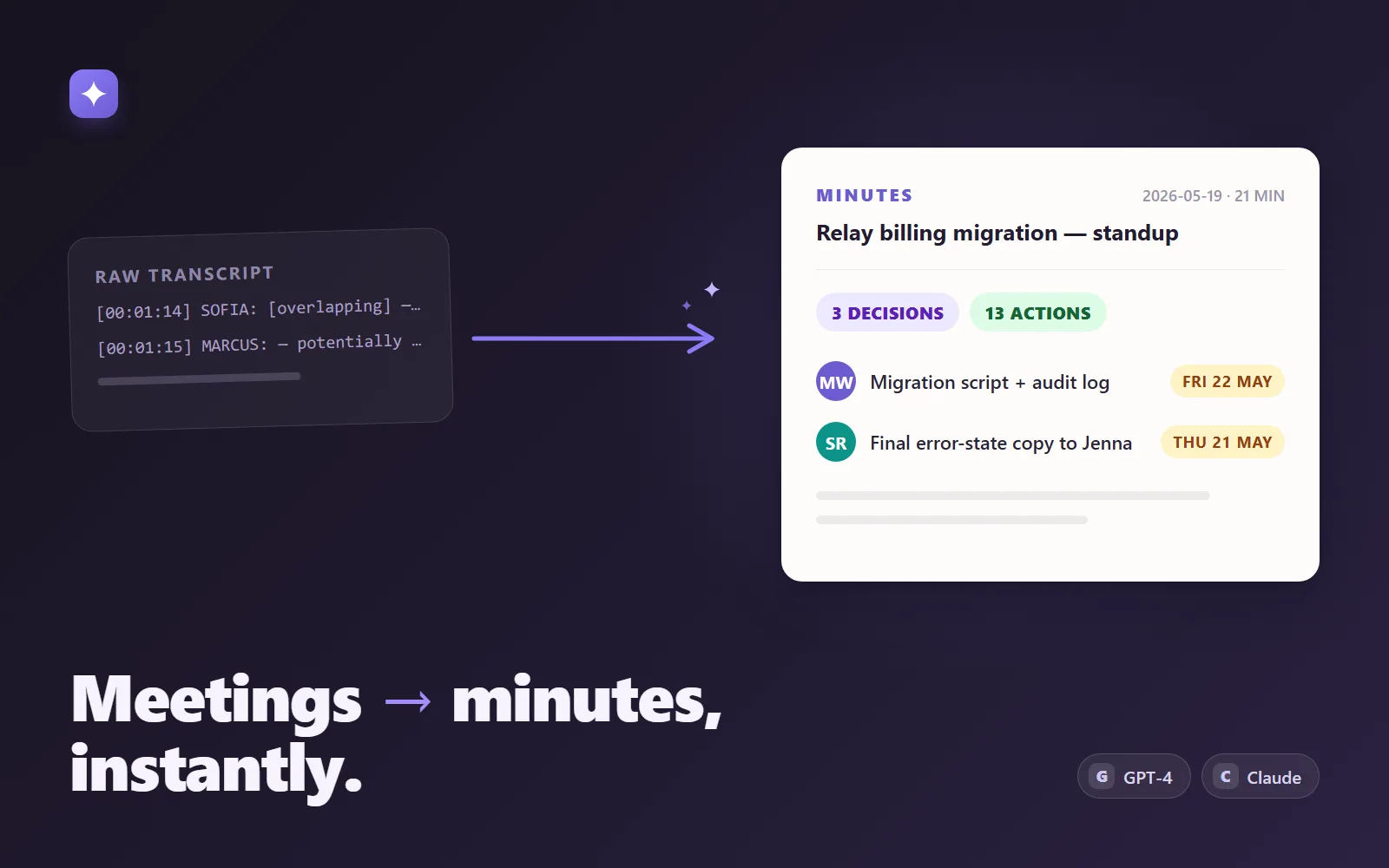
MinuteMaster — Meetings to Minutes AI System
Prompt system that turns messy meeting transcripts into accurate minutes, decisions and action items — never invents owners or dates.
Sample previewThorne Labs$49