Preparing for launch…
ReviewRadar — AI Review Responder
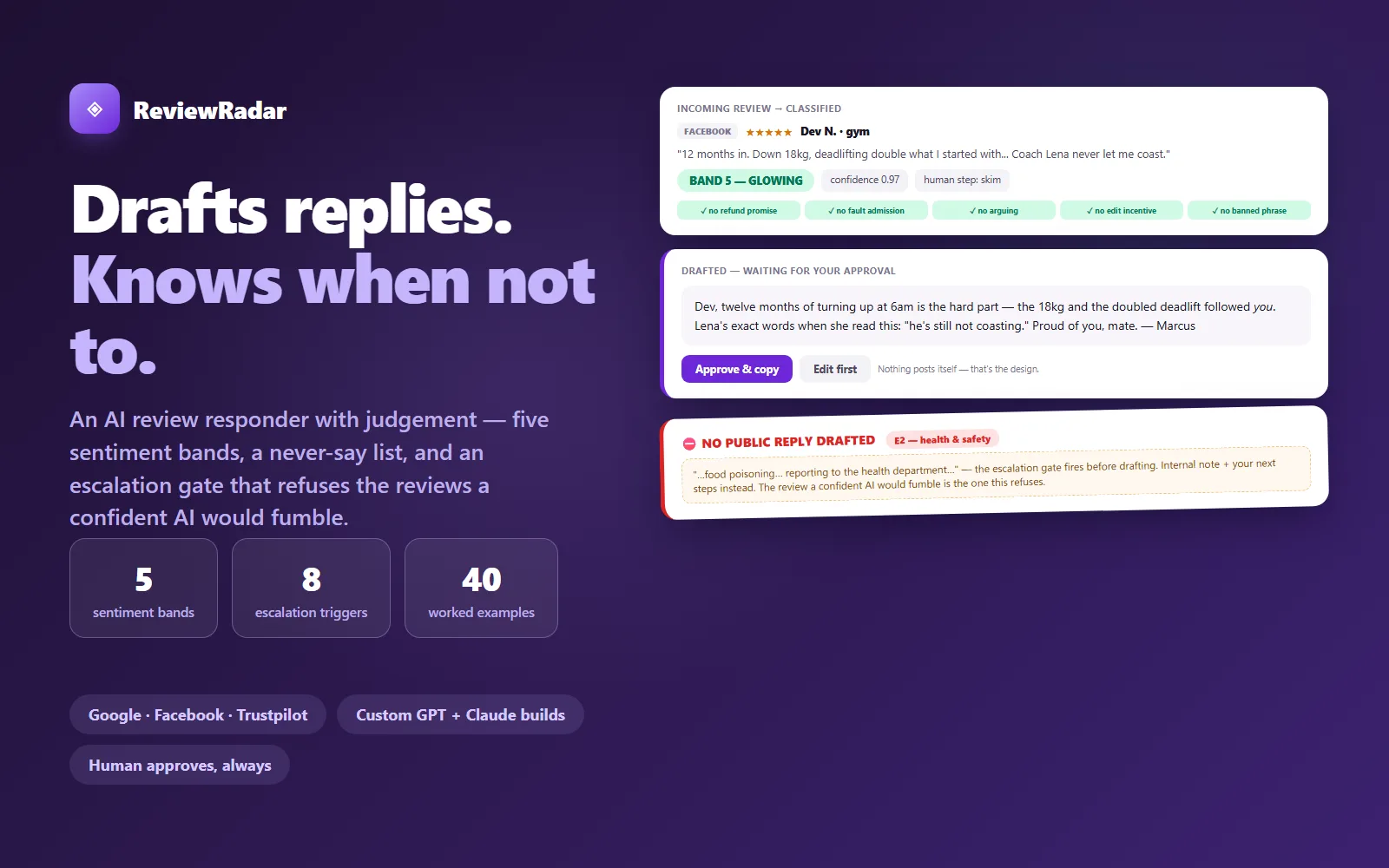
Reads your Google, Facebook and Trustpilot reviews and drafts on-brand responses for approval — grateful, specific, never defensive. And it knows which reviews to refuse.
What it does & who it's for
Every unanswered review is a public shrug, and every rushed reply is a risk. ReviewRadar is the middle path: an AI system that reads each incoming review, classifies it, and drafts a response in your voice for a human to approve — with real judgement about which reviews should never get an AI draft at all. Under the hood it's a modular prompt system, not a one-liner. The core prompt classifies every review into five sentiment bands — glowing, positive, mixed, unhappy, hostile — and each band has its own drafting rules: a 5-star rave gets the credit handed back to the customer; a 3-star mixed gets the praise acknowledged specifically and the complaint owned with one concrete fix; a 1-star rant gets exactly one reply that acknowledges the failure, skips all explanation and offers a named person — and never, ever argues. The escalation gate is the part that pays for itself the first time it fires. Eight triggers — legal language, health-and-safety claims, staff accusations, discrimination allegations and more — produce no public draft at all: you get an internal note and a documented next step instead, because the reply to "I'm calling the health department" should be written by you and your adviser, not a language model. A ten-item never-say list (no refund promises, no fault admissions, no incentives to edit a review) is enforced in the prompt and machine-checked in the structured output. You make it sound like your business with the tone-matrix worksheet: eight questions produce your voice profile, and three voice archetypes (warm & local, polished professional, playful) anchor the range. Forty worked examples across Google, Facebook and Trustpilot show exactly what the system produces — they're also your calibration set: run them through your build and compare. Deploy it three ways: a ChatGPT Custom GPT or Claude Project so anyone on the team can paste-review-get-draft; or the full API pipeline from the integration guide — nightly batch drafting, an approval queue, Slack delivery via Zapier/Make/n8n — with a JSON Schema validating every output and routing anything doubtful to a human. The live demo runs four real-shaped reviews through the system's actual rules — including the one it refuses to draft. What you watch is what the prompts produce.
What's included
- system-prompt.md — the core: five-band classification, the E1–E8 escalation gate, the N1–N10 never-say list, output contract - sentiment-modules.md — the five band-specific drafting rulesets (run all five, or individually for batch jobs) - platform-modules.md — Google / Facebook / Trustpilot conventions, length discipline and platform-policy tripwires - tone-matrix-worksheet.md — eight questions → your voice profile, plus the three voice archetypes - escalation-rules.md — the human-readable law behind every trigger: why it exists, what the model outputs, what you do next - response-library.md — forty worked examples across bands, platforms, industries and voices; doubles as your calibration set - output-schema.json — JSON Schema for structured runs, with the policy_check block that gates everything - custom-gpt-instructions.md — the ChatGPT Custom GPT build (engineered under the 8k cap) and the Claude Project build - integration-guide.md — API pipelines: nightly batch, approval queue, helpdesk macro, Slack via Zapier/Make/n8n - README-setup.md — the 30-minute start: worksheet → assembly → calibration → workflow
What's not included
- An AI subscription or API key (works with Claude or ChatGPT — chat plans are enough for the team builds; API costs fractions of a cent per draft) - Review-platform API access — drafts are approved and posted by a human, by design; the integration guide covers pulling reviews in, not auto-posting out - Auto-posting — deliberately absent everywhere. The golden rule of the whole pack: the prompt drafts, a human approves - Reputation-management services — this is a tool for answering your own reviews well, not a takedown service
Requirements
- Claude or ChatGPT (either; both builds included) — or any capable model via API for the pipeline path - Ten minutes for the tone worksheet before first use - A human in the loop — the system is engineered around approval, and bands 1-2 require a real read
Setup instructions
1. Do tone-matrix-worksheet.md first — eight questions, ten minutes, out comes your VOICE PROFILE block. 2. Assemble the working prompt in order: core → all five sentiment modules → your one platform module → your voice profile. 3. Build the team surface from custom-gpt-instructions.md (Custom GPT or Claude Project) — paste review, get draft. 4. Calibrate: run 5-10 reviews from response-library.md through your build and compare against the shipped responses. 5. Read escalation-rules.md end to end once — it's the law of the system, and the first E-trigger will make it the best money in the pack. 6. Optional: wire the API pipeline from integration-guide.md with output-schema.json validating every draft.
Version history
- v1.0Latest6 Aug 2026
Licence & terms
Licence terms
Single-business commercial licence. Use ReviewRadar for one business's review presence and adapt the prompts, voice and examples freely for that business. Agencies and freelancers: one licence per client business. You may not resell, redistribute or re-list the prompt system, the response library or derivatives of them as a template, prompt pack or product, whether paid or free.
Refund policy
14-day refund if the product is materially not as described in this listing or its demo. The demo shows the system's real outputs — including the refusal behaviour — so you can judge the writing and the judgement before buying. Refunds are not offered for change of mind or for third-party AI subscription costs. Open a refund request from your Launchstock library and we will respond within 2 business days. An approved refund ends your licence to the product — you must delete all copies of the files and stop using them.
Support terms
Email support (hello@thornelabs.dev) for 3 months from purchase, replies within one business day. Covers assembly, the calibration run, voice-profile tuning and the integration recipes on unmodified prompts. Custom voice development or additional platform modules are available as paid work.
These terms are snapshotted at purchase — what you see here is what applies to your order.
Reviews
No reviews yet
Reviews come from verified purchasers only, so you can trust what you read here.
More in Sales & Marketing
Other listings buyers compared with this one.